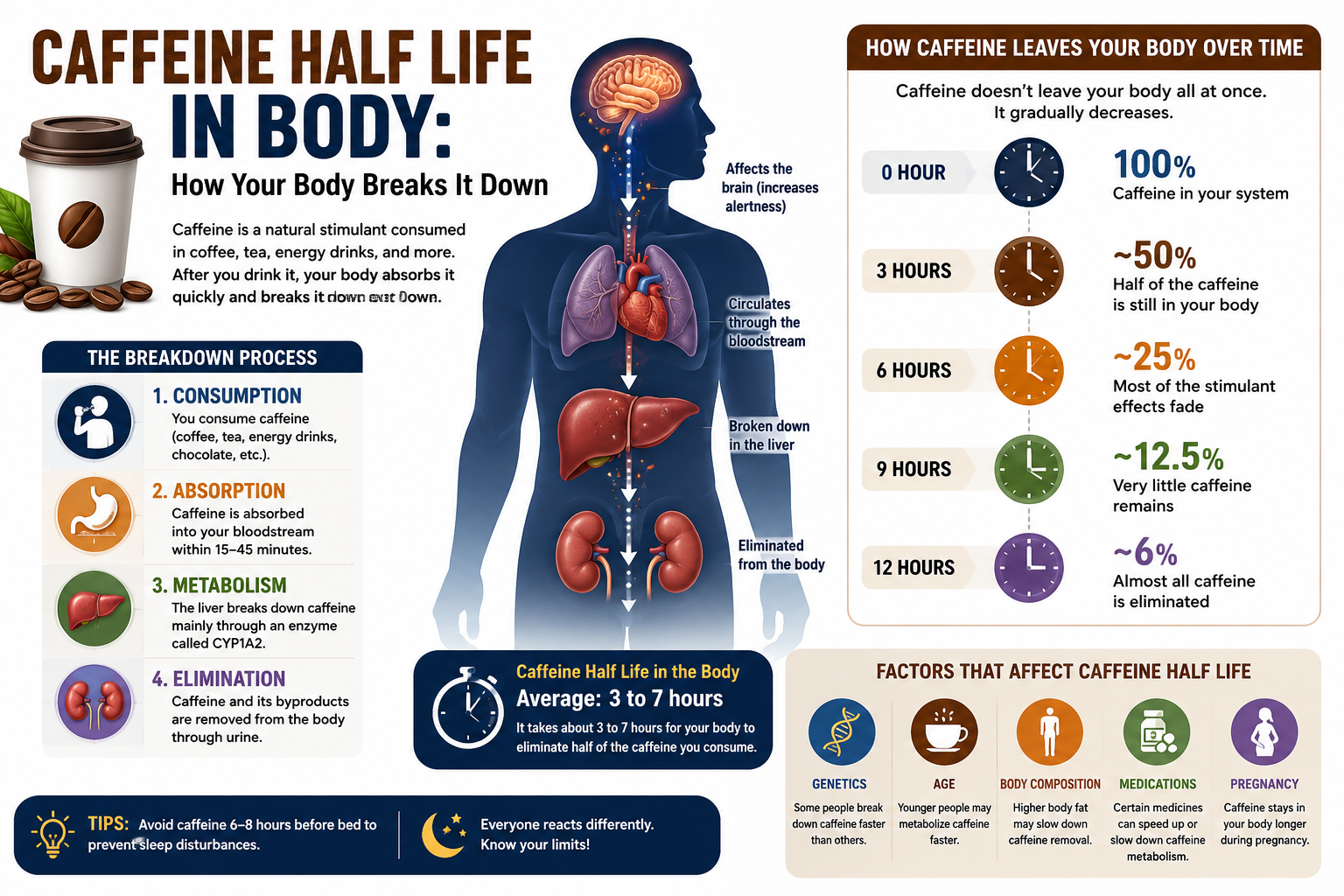
You have just finished drinking your afternoon cup of coffee. Now you are left wondering if it will ruin your sleep tonight. This question can be boiled down to one powerful idea: caffeine half life in body science. You get the hang of it, you treat your coffee breaks like a pro. This guide simplifies everything in layman’s terms. No confusing science terms. Just straightforward information you can implement today.
What does Caffeine Half Life if Caffeine Half Life?
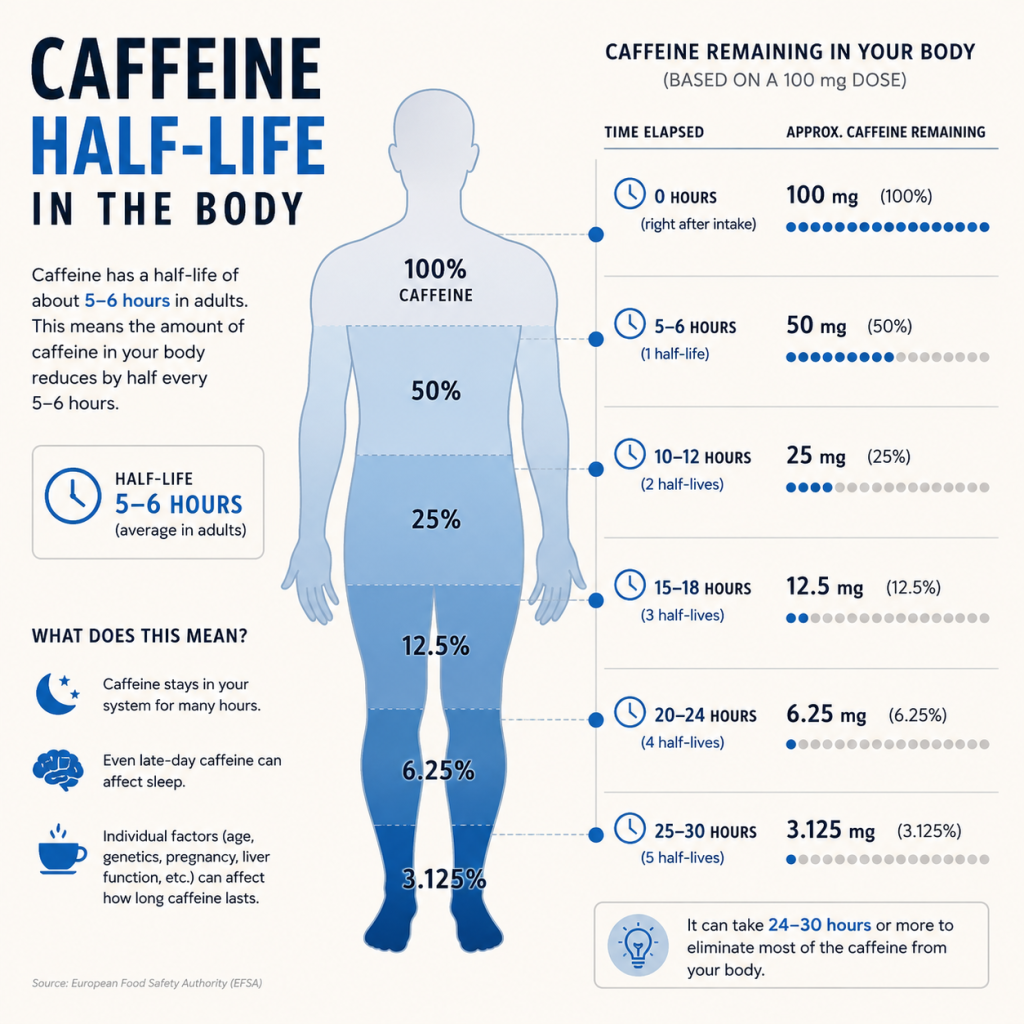
Half life refers to the period it takes for your body to eliminate half of the caffeine you consumed. After one half life, if you drink 200mg of coffee, there is still 100mg of coffee left in your body. The rest, over the coming hours, gradually dissipates from your system.
This number is not constant for everyone. Your caffeine half life in the body, however, is based on your age, weight, health of your liver and even your genes. Now two people could drink the same coffee and even hours later feel completely different effects.
Why This Number Matters
Learning your caffeine half life in body will help you to plan your day better. It will alert you when it is time to stop consuming coffee so that it will not interfere with your sleep. That also explains why it can make some people jittery for hours and have other people feel fine in an hour.
How long does caffeine remain in your body?
Caffeine itself has an average half life in health adults of approximately 5 to 6 hours. That means if you have that cup of coffee at 3 PM, you still have half of that caffeine in your body at 9 PM. By midnight, a little even sticks around. All of which is why that afternoon latte may be stealthily sabotaging your evening wind down. In truth, many people attribute their poor sleep to stress, but the real reason is caffeine that is probably still hanging out in their bloodstream.
The Science Behind Caffeine Breakdown
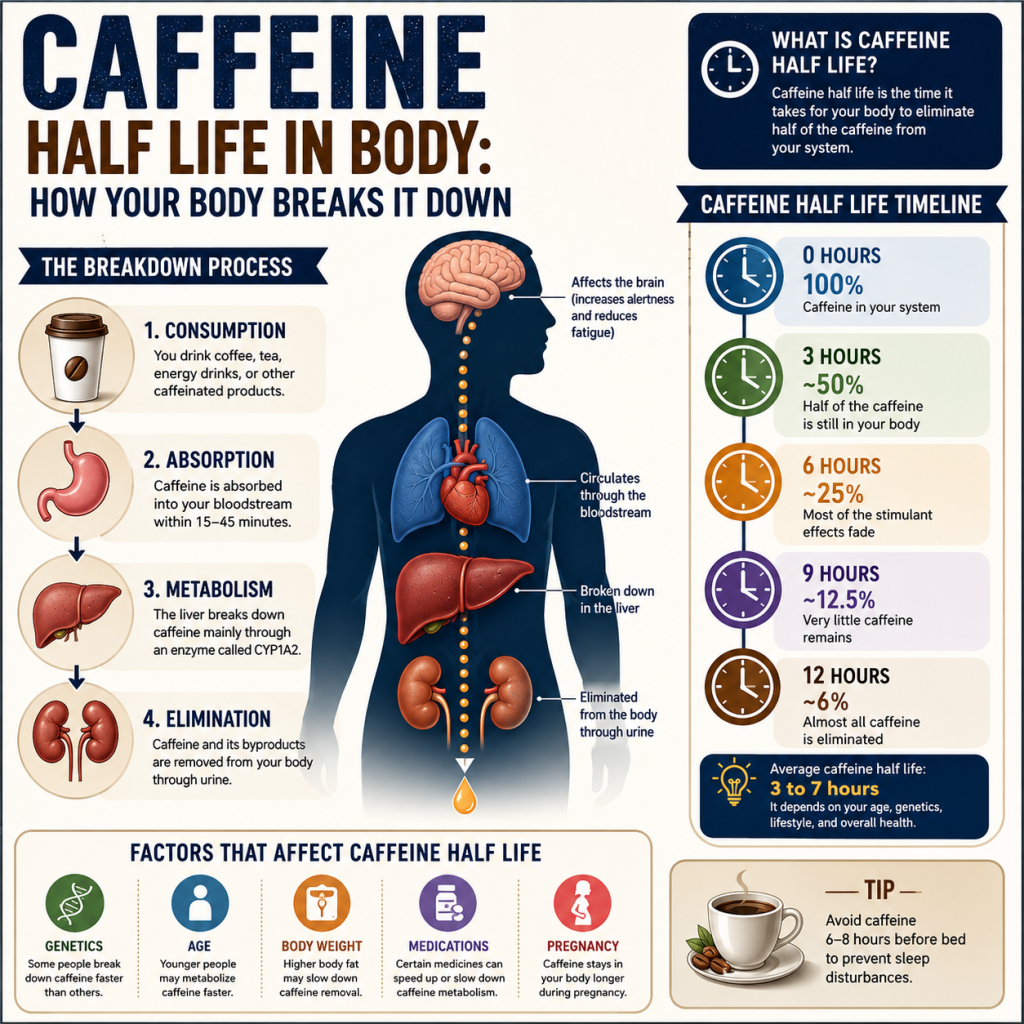
Your liver performs the most complex work here. Caffeine makes use of an enzyme deglycation to turn caffeine molecules into tiny parts. These fragments then exit your body through your urine. Not everyone produce this enzyme in equal quantities. Some metabolize caffeine faster. Others break it down slowly. Hence the reason your friend can nap instantly after coffee and you cannot.
Also read Factors That Affect Your Half Life Of Caffeine
Your body is not a robot. Several factors that accelerate or decelerate the elimination of caffeine from the body. Let’s examine the largest.
Age and Metabolism
Babies and older adults process caffeine at a much slower rate than younger adults. Breast milk can take several days for a new-born baby to clear caffeine. And it’s just as common for older adults, who tend to metabolize drugs slower because liver function declines with age. Younger adults with a rapid metabolism tend to clear caffeine more quickly. This is why teenagers can drink an energy drink at night and still fall asleep faster than adults ever will.
Pregnancy Changes Everything
About 50% of caffeine is eliminated from the body every few hours but that half life is double to triple during pregnancy. It can take up to around 15 hours for a pregnant woman to clear half the caffeine she ingests. And this is the reason why doctors recommend to reduce coffee consumption during pregnancy. Plus, a developing liver in the baby still can’t process caffeine. What this means is caffeine accumulates in the system and lingers for an extended amount of time as opposed to the norm. This is where you should switch to decaf those nine months.
Liver Health Plays a Big Role
Most of it is metabolized by your liver. This process is VERY slow if you have liver disease Cirrhosis sufferers may take double the time to eliminate caffeine than someone with a healthy liver. Alcohol or certain medicines could also mildly affect the liver, thus slowing it down. If, for instance, your mornings stretch into the early afternoons and you buzz or crash sporadically after your first cup of coffee, the liver might be under siege.
Smoking Speeds Things Up
Here is something surprising. In fact, it is known that cigarette smokers have faster clearance of caffeine than non-smokers. Nicotine increases the liver enzyme that metabolizes caffeine, nearly halving its half life. That means smokers have to drink more coffee to feel the same buzz. This also explains why quitting smoking can suddenly make your morning cup of coffee feel like espresso
Your Genes Decide a Lot Too
It is controlled subliminally by genetics as to how long this half life for caffeine is inside your body. Others, by contrast, inherit a variant of a gene which makes them speedy metabolizers. Some have a sluggish form of that exact same gene. A fast metabolizer will have no issue drinking coffee at night and sleeping just fine. Slow metabolizers experience the effects of caffeine for far longer. Your genes might be responsible, if you always feel jittery from just one cup.
Caffeine Half Life in Body: Quick Reference Table
Here is a simple table to help you understand how different factors change caffeine clearance time.
| Factor | Average Half Life | Notes |
|---|---|---|
| Healthy adult | 5 to 6 hours | Normal baseline |
| Pregnant woman | 9 to 15 hours | Slows down a lot |
| Newborn baby | Up to 4 days | Liver still developing |
| Smoker | 3 hours | Faster liver enzyme activity |
| Person with liver disease | 8 to 10+ hours | Depends on severity |
| Person on birth control | 8 to 10 hours | Hormones slow breakdown |
| Older adult (65+) | 6 to 8 hours | Metabolism naturally slows |
This table shows how wide the range really is. Your caffeine half life in body is truly personal, not a fixed number you can copy from a friend.
Why Caffeine Half Life Matters for Sleep
Sleep experts often say to avoid caffeine after 2 PM. This advice comes straight from half life science. If your last coffee is at 2 PM, a good chunk of it may still be active at bedtime. Caffeine blocks a brain chemical called adenosine, which normally makes you feel sleepy. As long as caffeine sits in your blood, this chemical cannot do its job properly. That is why one late coffee can lead to tossing and turning at night.
A Simple Real World Example
Now, let us say you have a 100mg cup of coffee out at 6 PM. Around midnight there is still 50mg in the blood half. At around 6 AM it will likely have decreased to around 25mg or so. And, even when you do fall asleep, that left-over caffeine continues to prevent your sleep from being as deep and restful as it should. When you Have Coffee matters just as much as How much Coffee you Have Those with a slower caffeine half life in body can have even a small afternoon cup meaning a restless night.
How To Calculate How Much Caffeine Is Left In Your System
No science degree required to reach this conclusion. Just use this simple method. Divide according to the half life of your caffeine.So if you have 200mg of caffeine, it becomes 100mg after 5 hours. In 10 hours, it reaches 50mg. Then it(gets) reduced to 25mg after 15hour. So, while this is a rough math you have a good sense of when your body is going to be caffeine free again.
Why This Trick Is Useful
Then this trick can help you plan your nap or workout, or bedtime. Its often used by athletes to time pre-workout drinks so caffeine does not interfere with evening sleep. It is also utilized by students, especially before exams because good sleep at the right time counts. Talking by the facts Practical ways to Deal with Your Caffeine Half Life in Body Even small modifications can significantly change how caffeine impacts a day. Follow these very simple tips so that you can feel more in control.
- Suspends coffee at least 8 hours before going to bed.
- Wean off afternoon caffeinated drinks in favour of decaf or herbal tea.
- Keep yourself hydrated since water helps liver function.
- Be cautious about hidden sources of caffeine, like chocolate, soda, and some medicines.
- You have to track how you feel personally after coffee to see your pattern.
Following are not hard rules; they are tips. They are easy habits that are aligned with reality of how your body processes caffeine (the half life). Everybody is different, so adapt depending on how you cope.
Frequently Asked Questions
How long does caffeine actually stay in your bloodstream?
On average, caffeine remains in your bloodstream for five to six hours. Others clear it relatively quickly, while many take a lot longer. This timetable of course varies greatly based on playing variables, such as liver fitness and genetics.
Can I speed up caffeine removal with water?
Your water helps to maintain your entire body, but it does nothing to break down the caffeine faster. Caffeine is primarily metabolised in your liver. Keeping your water intake up is just more about giving your body every tool it needs to function that much better.
Why do I feel caffeine effects longer than my friends?
It could even be that you have a slower liver enzyme that breaks down caffeine at a slower rate. Genetics factor highly into this difference. Some drugs and conditions, like pregnancy and advancing age, can also prolong the effects.
Is daily coffee bad for you?
For the majority of healthy adults, daily java is completely fine when done right. Discover this: the problems only come that caffeine has accumulated too largely way too near bedtime. Give your cups some time between them to prevent nightmares at night.
What time should I stop drinking coffee to have a good night sleep?
Experts recommend to avoid drinking coffee in the second half of the afternoon (2 PM). This allows your body to clear most of it by bedtime. Adapt this timing relative to your own half life of caffeine in the body.
Final Thoughts
Once you understand caffeine half life anywhere in the body, you will be treated as a king over energy and sleep. And this might explain why the same coffee has such a different effect on people. Caffeine lingering in body is also a factor of age, pregnancy liver health, smoking and genetics.
Average half life is between 5 to 6 hours, but this varies a lot based on the individual. Utilize the above table and tips to time your coffee wisely. Just a handful of tweaks can be the pathway to more restful nights, more stable energy, and no more rattling afternoons.